Low-moisture sand prevents material caking and equipment clogging, ensuring uniform conveying and mixing while boosting production efficiency; it also minimizes the impact of moisture fluctuations on mix ratio accuracy, guarantees consistent product quality, and reduces both drying energy consumption and the risk of equipment corrosion.
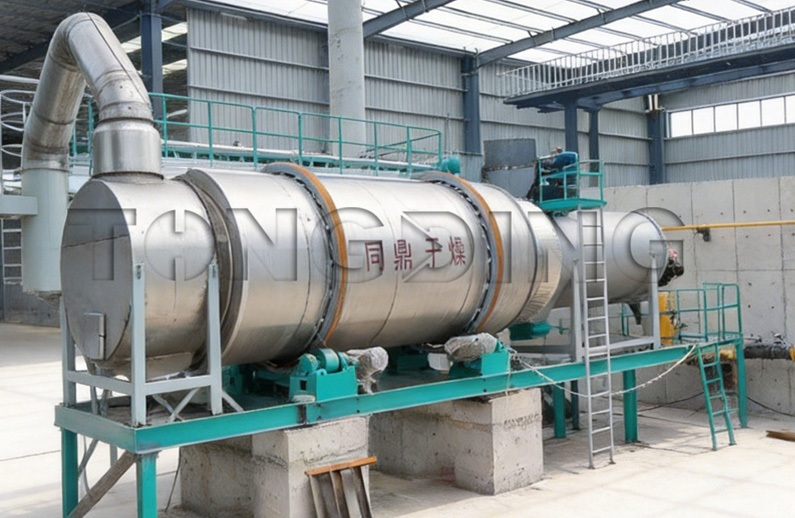
Common challenges include material agglomeration, wall adhesion, uneven moisture content, and high energy consumption. To avoid over-drying, precise control of hot air temperature and residence time is required; additionally, the installation of online moisture monitors, along with the use of staged drying and waste heat recovery, ensures that the final product’s moisture content consistently meets specifications.
The main types include rotary drum dryers, triple-pass dryers, vertical dryers, belt dryers, and flash (pneumatic) dryers. Among them, the triple-pass dryer offers high thermal efficiency, while the rotary drum dryer is the most widely used.
Key factors include the initial moisture content and particle size of the sand, dryer type and rotational speed, hot air temperature and airflow rate, residence time, lifter design, and ambient temperature and humidity. Properly matching these parameters can significantly enhance dewatering efficiency.
1.Pre-treatment: Screen out impurities and ensure uniform feed particle size.
2.Feed control: Ensure uniform feeding to prevent clogging or overloading.
3.Drying: Set hot air temperature and rotation speed; employ staged dehydration to prevent the surface from becoming overly dry.
4.Online monitoring: Monitor discharge moisture in real-time and dynamically adjust parameters.
5.Cooling and discharge: Cool the material and store it in sealed conditions to prevent re-absorption of moisture.
6.Waste heat recovery: Utilize waste heat from exhaust gases to preheat the feed, thereby saving energy and reducing consumption.
Recommendation: Utilize a triple-pass or waste-heat recovery dryer; precisely control hot air temperature and airflow; ensure uniform feeding to prevent overloading; enhance thermal insulation to minimize heat loss; regularly clean the lifting flights and ducts; and employ online moisture monitoring to enable on-demand drying and avoid over-drying.
When making a selection, consider processing capacity, initial and target moisture content, the type of heat source, and site conditions. Prioritize models with high thermal efficiency and strong adjustability; evaluate the manufacturer’s qualifications and track record; request test-run data; and ensure reliable after-sales service and spare parts availability.Tongding sand dryers are your top choice.
| Model | HG2240 | HG2958 | HG3270 | HG3890 | HG4512 |
| Overall dimensions (m) | 2.2×4 | 2.9×5.8 | 3.2×7 | 3.8×9 | 4.5×12 |
| Simple volume (m³) | 9.1 | 23.8 | 35.4 | 65.3 | 125.6 |
| Simplified form: Rotational speed (r/min) | 8-10 | 6-8 | 6-8 | 4-6 | 4-6 |
| Power (kW) | 7.5 | 22 | 44 | 60 | 75 |
E-mail :
info@tongdingmachinery.comTel / Whatsapp / Wechat :
+86 18137870873Fax :
+86 037163715718Copyright © Zhengzhou TONGDING Machinery&Equipment Co., Ltd.Power by yisainuo

